


On the surface, science should be a trusted guide in shaping public health and policy. But in practice, it often leaves the public confused, frustrated or misled.
As scientific research filters through press releases, journal agendas, and news cycles, accuracy frequently gives way to distortion. That erosion of clarity can have real-world consequences.
In a climate where skepticism about science is growing, media reporting plays a crucial role—for better or worse.
A Crisis of Certainty
The public craves simple answers: Is this safe? Should I eat this? Will this work?
Science, however, rarely deals in absolutes. Its conclusions are provisional, based on available evidence, and open to revision. That nuance is lost when headlines oversimplify evolving research. This mismatch between public expectation and scientific process fuels mistrust.
That trust is further strained when studies are hyped by outlets chasing clicks, only to later be contradicted or quietly revised. It’s a dynamic that reveals a deeper paradox: science overpromises through exaggerated media coverage and underdelivers because real-world evidence is inherently complex.
How Science Really Works
Science is not a repository of eternal truths. It’s a method of reducing uncertainty over time. The process is slow, competitive and iterative.
New hypotheses are tested, rejected, refined. Findings undergo peer review, are challenged, replicated, or discredited. Scientific consensus is built gradually. And yet, the public often sees changing recommendations—on nutrition, vaccines, or medications—as signs of failure rather than progress.
Part of this confusion stems from overconfidence. The Dunning-Kruger effect explains how people with low expertise often overestimate their understanding. The phenomenon is sometimes summarized as “ignorance more frequently begets confidence than does knowledge.”
Without the tools to interpret study design or statistical significance, even well-meaning readers—and journalists—can get the story wrong.

8 of Cups
The pursuit of certainty in science has often been a slow, linear process—restrictive, even—like a boat flanked by cliffs. But the 8 of Cups signals movement away from confinement and into open waters. It suggests a broadening of research horizons: new questions, interdisciplinary breakthroughs, and a shift away from binary thinking. Discovery may flow more freely when the boundaries come down.
Conflicts of Interest in Medicine
Scientific credibility is further complicated by commercial influence.
Many studies are funded by pharmaceutical companies or industries with vested interests. This doesn’t automatically invalidate results, but it does demand scrutiny. Disclosures of financial ties are now standard, but not always transparent.
Most researchers today simply wouldn’t be able to fund studies without the backing of pharmaceutical companies, large supplement brands, or contract research organizations.
The statins controversy illustrates the stakes. Statins are a widely prescribed class of cholesterol-lowering drugs, often used to reduce the risk of heart disease.
When The BMJ—one of the “Big Five” medical journals—questioned the benefits of statins for low-risk patients, critics accused it of sensationalism. But the journal’s position reflected a growing concern in parts of the medical community: that statins may be overprescribed, come with underreported side effects, and lower cholesterol indiscriminately—including HDL, the commonly known “good” cholesterol—rather than targeting the specific risk factors that truly matter.
The British Heart Foundation pushed back, concerned that public doubt could lead patients to stop life-saving medication. Some policymakers warned of “thousands of preventable strokes and heart attacks”—a projection that remains controversial among researchers and practitioners critical of statin overuse.
While debate is essential, controversy can be manufactured—by journals selling copies, or by media outlets seeking attention. Both science and journalism have incentives that don’t always align with public interest.
The Media’s Influence on Medical Decisions
Health journalism shapes public behavior. When coverage is inaccurate or biased, consequences follow.
Doctors themselves struggle to keep up with a flood of new findings. General practitioners have reported low confidence in discussing evolving topics like statins. Media noise worsens this, presenting conflicting data without context or consensus.
The result: patients and doctors alike are left unsure about what—or whom—to believe.
Professor Peter Weissberg CBE, former Medical Director of the British Heart Foundation and inaugural British Heart Foundation Professor of Cardiovascular Medicine at the University of Cambridge, noted a shift toward advocacy in editorial content.
Journals, once committed to objectivity, now risk amplifying fringe views to generate attention. That creates a feedback loop: media outlets elevate contentious takes, audiences respond, and nuanced science is drowned out.
The Sensationalism Trap
Most journalists covering science are not scientists. Many lack formal training in interpreting data or understanding study limitations. Still, they’re expected to translate complex findings under tight deadlines and editorial pressure.
When I was working at the news desk of a science publication, reporters were generally expected to produce three to five news stories by lunch—between 9 a.m. and 12 p.m.—and then follow up with a few in-depth pieces in the afternoon. That pace left little time to thoroughly analyze research or vet studies with the care they often require.
To make research “newsworthy,” press releases often inflate significance or ignore uncertainty. Embargoes sometimes limit journalists’ access to full studies, pushing shallow reporting. As a result, preliminary findings are presented as groundbreaking, while null results—or replication failures—get little attention.
Nowhere was this clearer than the MMR vaccine scare. One flawed study led to years of fear-mongering, amplified by media outlets prioritizing controversy over accuracy. The fallout was a rise in vaccine hesitancy that still haunts public health today.
But the lesson cuts both ways: overly aggressive promotion of newer vaccines without sufficient long-term data can also backfire. In Europe, for instance, the Gardasil vaccine—aimed at preventing cervical cancer—was heavily pushed in schools, often through public health incentives.
Teenage girls were encouraged to undergo a three-dose course, with strong backing from nurses, doctors, and parents. In the years that followed, isolated reports of severe adverse effects and even adolescent deaths raised concerns about whether side effects had been fully understood. While no causal link was definitively proven, the episode fueled further skepticism—highlighting the danger of rushing vaccine messaging ahead of the science.
These kinds of controversies also underscore how easily scientific nuance gets flattened by media habits—especially the illusion of “balance.”
The Illusion of “Balance”
In science reporting, false equivalency is a persistent problem. Presenting “both sides” of a debate works in politics—not in science, where evidence, not opinion, determines validity.
Climate change and vaccine safety are two stark examples. In many cases, a handful of contrarian voices are given equal weight to overwhelming scientific consensus—leaving the public with the impression of a broad scientific divide where there is little or none.
But in other cases, like emerging vaccine technologies, legitimate scientific debate does exist—and collapsing that nuance into a binary harms public trust.
Christie Aschwanden, the former lead science writer at FiveThirtyEight and contributor to outlets including The New York Times, Scientific American, and The Washington Post, noted that many people view science as gospel or fraud. But science lives in the middle—a process of constant questioning and self‑correction. That distinction is rarely made clear.
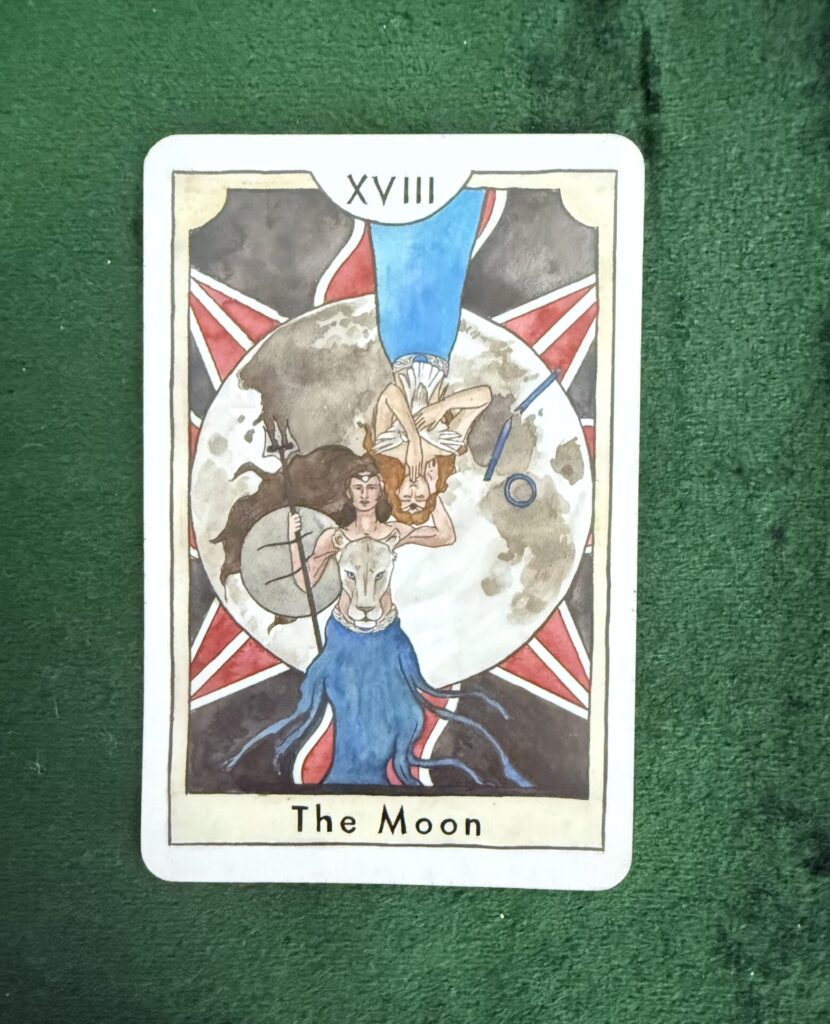
The Moon
Hidden knowledge comes to light. The Moon points to revelations in fields where access was once blocked or findings were incomplete. What was once tightly controlled may become visible—prompting a collective reevaluation of long-held beliefs. This card speaks to the discomfort of uncertainty, and the growing demand for transparency in science and messaging.
The Burden of Communication
Even open-access studies are often indecipherable to lay readers. Jargon, statistical modeling, and complex language create barriers. When people can’t understand the data themselves, they turn to shortcuts—sometimes conspiracy theories or charismatic contrarians who promise clarity.
That opens the door to misinformation. A powerful defense mechanism—the sense of being privy to hidden truth—takes hold. As New Scientist reported, this illusion of secret knowledge fuels distrust in both mainstream science and journalism.
The solution is not to dumb down science, but to teach people how to ask better questions: Who funded this? Is the sample size large enough? Was it peer-reviewed? Does it reflect broader consensus?
What Trustworthy Research Looks Like
There are ways to evaluate the reliability of health research. Trusted studies typically have:
- Large, randomized sample sizes
- Clear and measurable outcomes
- Replicable methods
- Transparent funding and disclosures
- Peer review by independent experts
- Registration of clinical trials beforehand
- Absence of unexplained outliers in the evidence
- A clear progression through research phases
- Absence of “p-hacking”
- Practical, not just statistical, significance
- Accessible data for independent scrutiny
As the BMJ’s open-data campaign shows, transparency matters. For example, the BMJ’s open-data campaign revealed that complete statin trial data had long been unavailable to independent researchers.
Without access, meaningful review and public debate suffer. The issue isn’t limited to older drugs either: in 2021, the FDA initially moved to keep some of Pfizer’s COVID-19 vaccine trial data under wraps for 75 years, before being ordered by a judge to release it sooner. Independent scrutiny is not optional—it’s essential.

5 of Cups
This card reflects past disappointment—perhaps funding misallocated, or research that led to dead ends. Yet two upright cups remain, pointing toward new directions. One aligns with the top of the pentagram, hinting at the rise of the unconventional: quantum theory, metaphysical studies, or research once dismissed as fringe. As minds expand, so may our scientific scope—toward phenomena once kept in the shadows, as hinted by The Moon, and embraced by the expansive current of the 8 of Cups.
Toward Better Science Reporting
Improving trust in science requires reform—in both media and research institutions.
Calls have been made for penalties for misreporting, similar to libel laws. The 2012 Leveson Inquiry recommended replacing the now-defunct Press Complaints Commission (PCC) with an independent regulator empowered to fine outlets and mandate prominent corrections. A regulatory structure was even set up under a Royal Charter, and Impress—the only body to meet the new standards—was created.
But in practice, most major newspapers refused to join. Instead, they operate under IPSO, a successor body widely criticized for lacking independence and teeth. Section 40 of the Crime and Courts Act, which would have incentivized publishers to sign up for meaningful regulation, has never been enacted. Despite the framework being in place, the proposed reforms were largely shelved.
The Science Media Centre in the UK has outlined best practices: explain uncertainty, avoid sensationalism, and prioritize consensus over clickbait. But adoption remains patchy.
Government inquiries, such as the UK Parliament’s report on science communication, reveal public frustration. Only 28% of people believe journalists check the reliability of studies before reporting. And 71% believe science is routinely sensationalized.
The result is a regulatory vacuum—and a continuing erosion of public trust in science journalism.
The Path Forward
The goal of science journalism is not certainty, but clarity. Reporters must stop pretending every study is a revelation. Scientists must explain not just what they know, but how they know it. And the public must grow more comfortable with complexity—not binary answers.
True scientific authority lies not in individual studies, but in the consensus built through rigorous testing and collective skepticism. That process may be slow, but it is self-correcting.
To restore public trust, the media must take its role seriously. Journalism should serve as a filter—not a funnel—translating science with accuracy, integrity, and context.

Sources
- CDC: How Do You Know Which Health Care Effectiveness Research You Can Trust?
- Science: Editorial by Jeremy Berg
- The New Yorker: The Mistrust of Science
- BMJ: Statins Open Data Campaign
- NYT: When Doctors Have Conflicts of Interest
- PLOS Medicine: What Is Useful Clinical Research?
- UK Parliament: Science Communication Inquiry
- WHO Bulletin: Science Reporting Standards
- New Scientist: How to Tell Truth from Lies
- YouTube: Media Misuse of Science
- Live Science: What Is the Dunning-Kruger Effect?